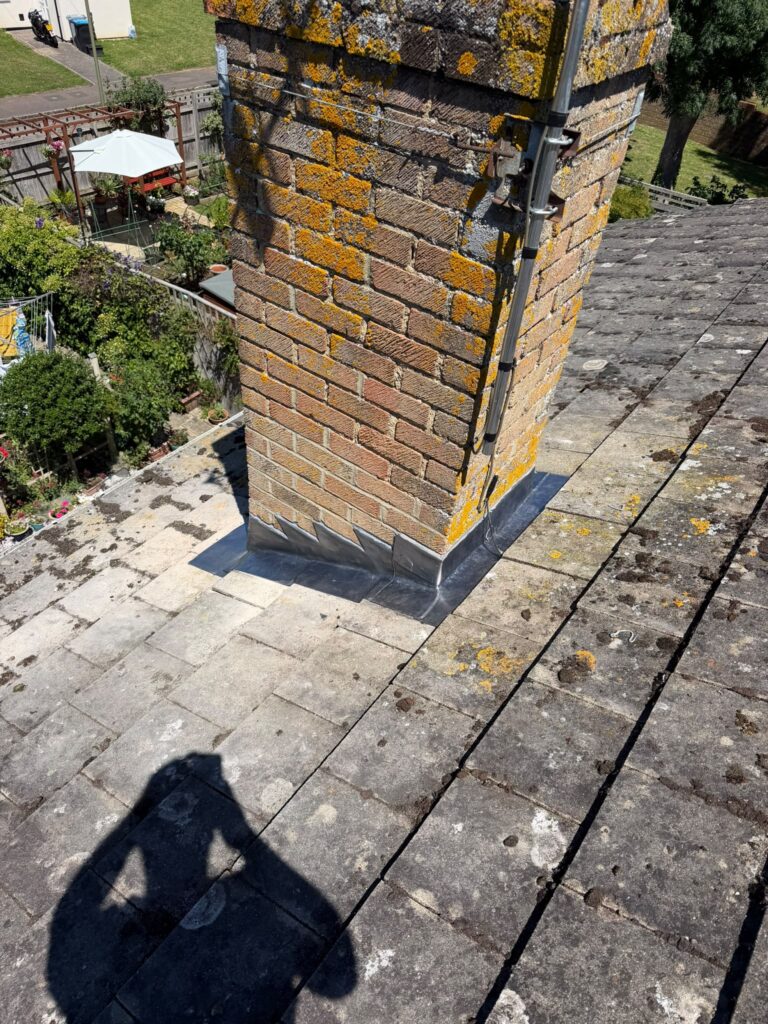
Not every job is a college roof. This one was a single chimney stack on a house in Carterton, Oxfordshire, where the old flashings had given up and water was finding its way in around the stack. The lead was stripped off and replaced with new Code 5 milled lead, cut and dressed to the brickwork and the tile profile.
Scope of works
- Removal of the existing failed flashings
- New Code 5 milled lead front apron, stepped flashings and soakers
- New lead back gutter to the upslope face of the stack
- Flashings chased into the mortar joints, lead-wedged and repointed
- Patination oil applied on completion
Why chimneys leak
A chimney is one of the few places on a house where a vertical masonry wall pushes straight through a pitched roof, and every one of those junctions has to be weathered separately. Most stacks that let water in are not cracked or failing structurally — the flashings around them have simply come loose, pulled out of the mortar, or been patched at some point with cement or mastic that has since shrunk and split.
Done properly, the job is four separate pieces of lead working together: an apron across the front face, soakers interleaved with the tiles up each side, stepped flashings cut into the brickwork to cover them, and a back gutter behind. Each is cut to follow the mortar courses, wedged into the joint and pointed, so the lead holds itself in place rather than relying on adhesive.
The result
Code 5 milled lead is the right weight for domestic flashings — heavy enough to stay where it is put and to take the weather, without being so stiff that it cannot be dressed neatly into a tile profile. Finished with patination oil to stop the white carbonate staining that new lead otherwise runs down the brickwork, the stack should now be watertight for decades with no maintenance beyond the odd look over.
Small jobs get the same detailing and the same materials as the listed buildings we work on. If you have a stack that is letting water in, we are happy to come and look at it.