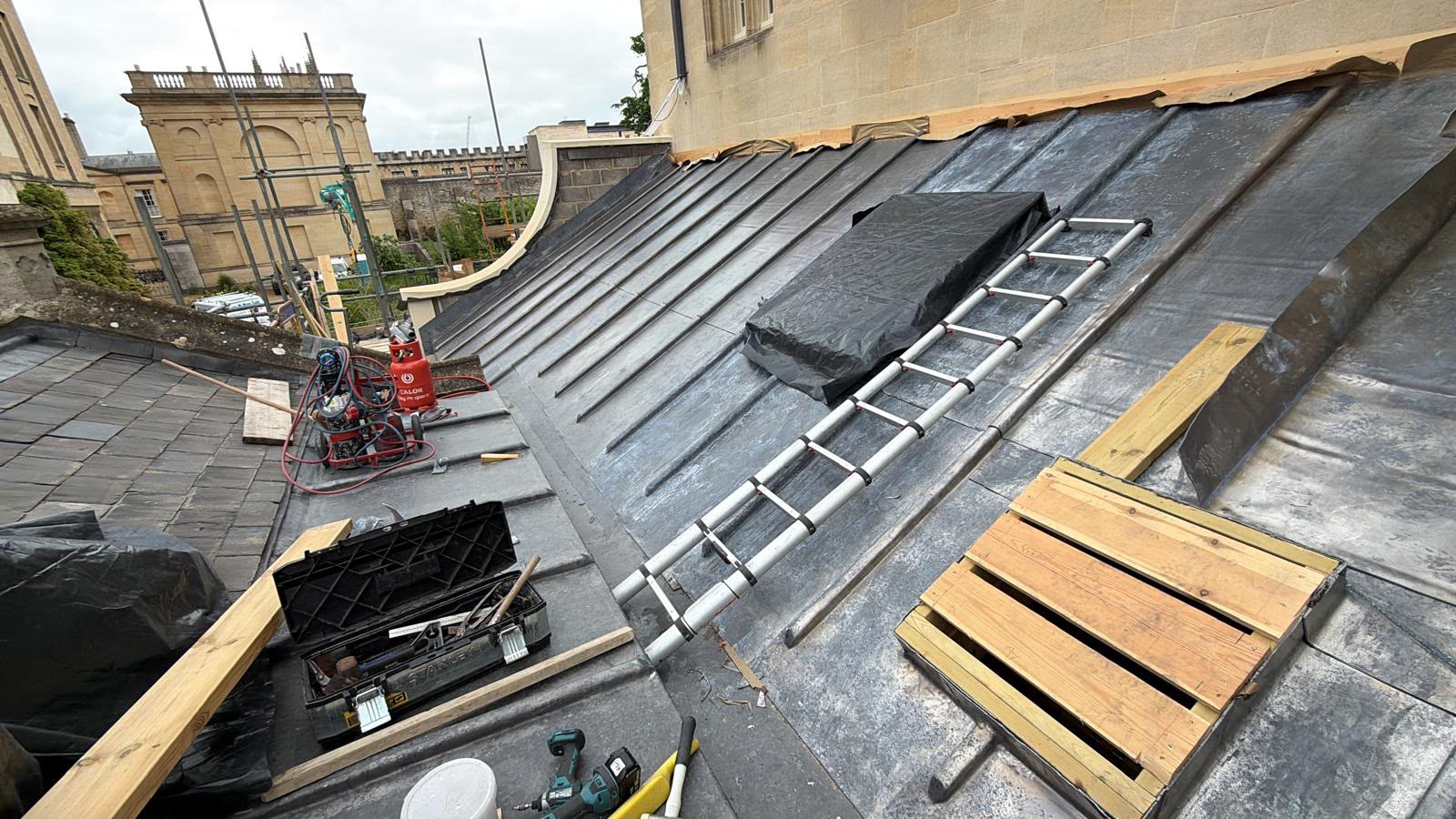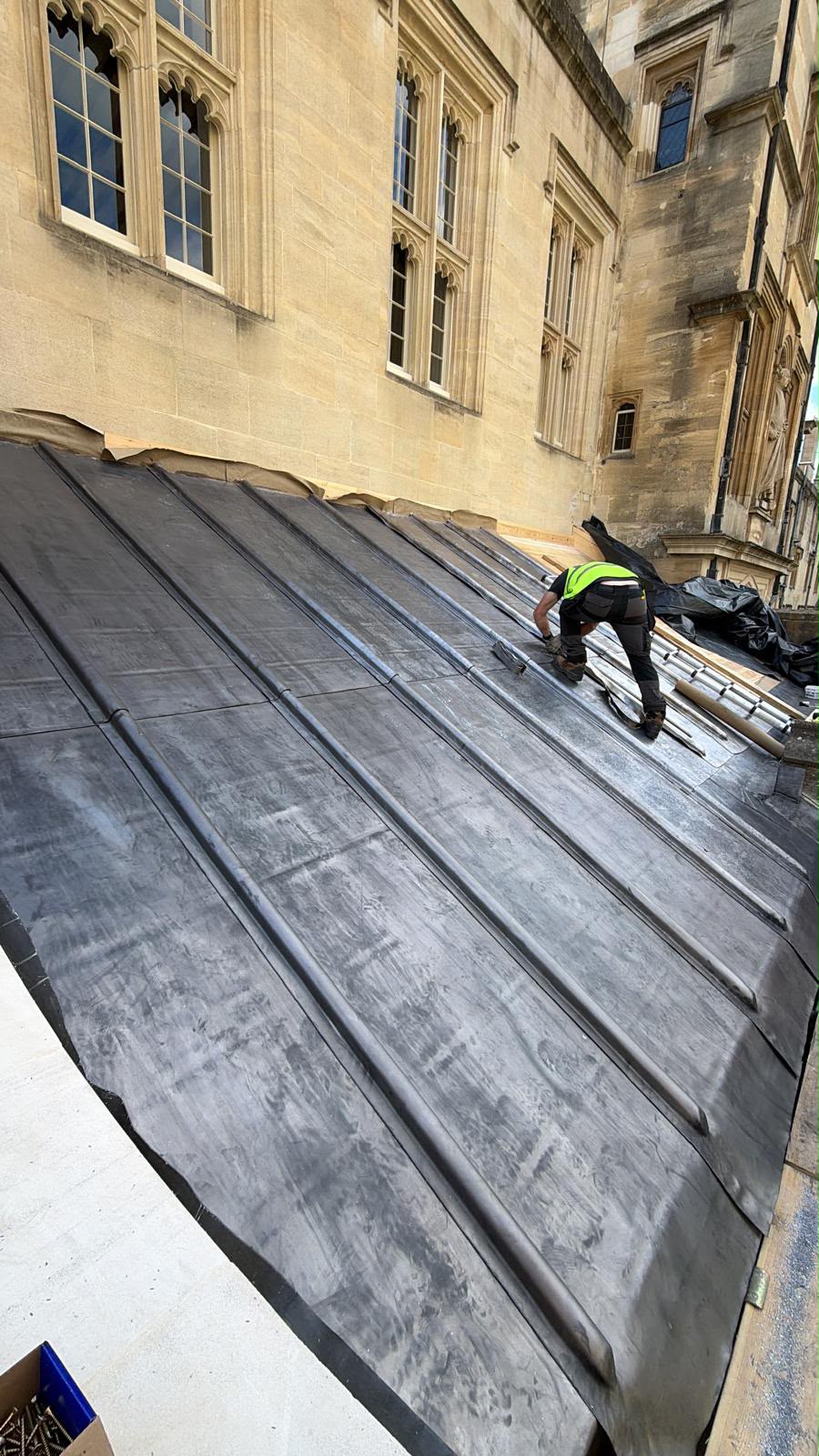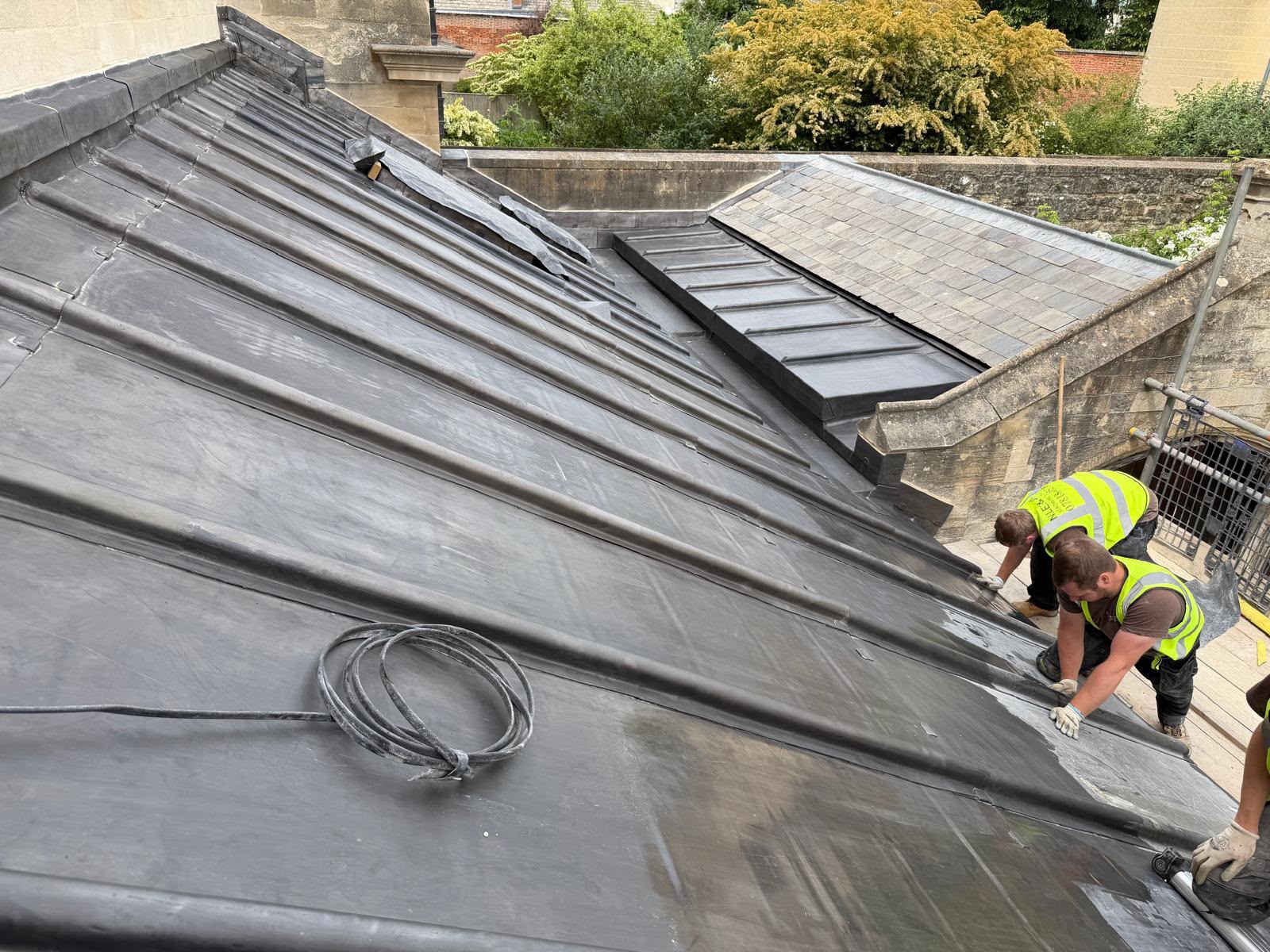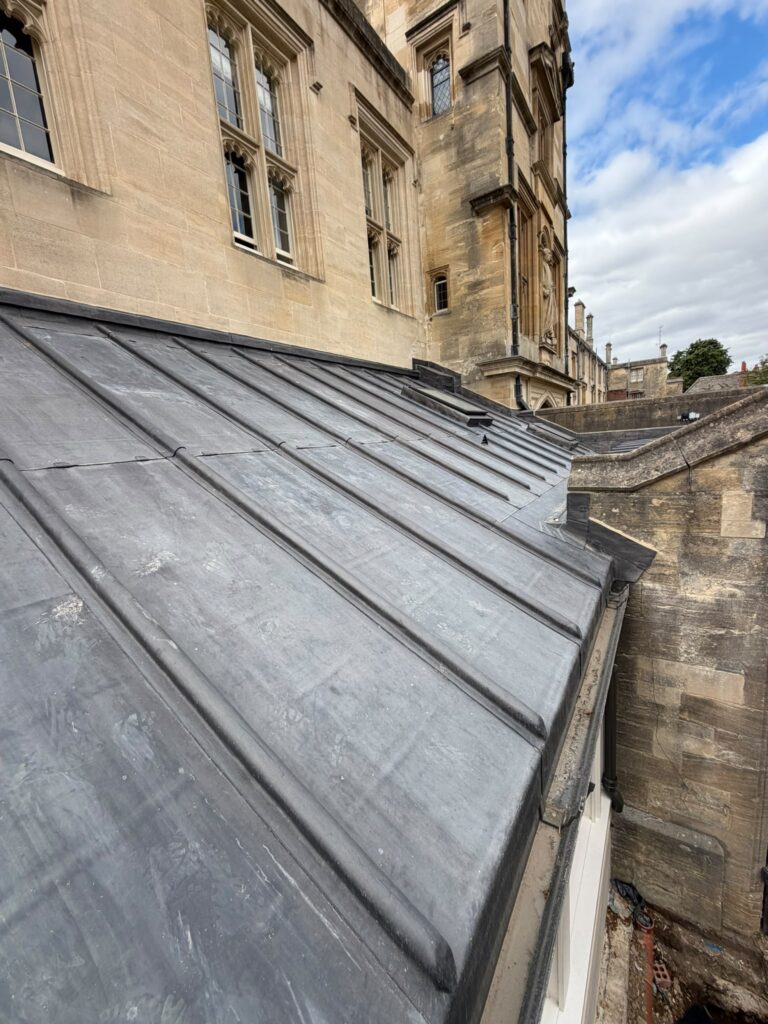
N Lee & Son were appointed to carry out the leadwork to a new extension at the Deanery, Christ Church, Oxford. The extension provides a new PA office for the Deanery, and sits hard against the existing historic elevation, so the finished roof had to read as part of the building rather than as an addition to it. New Code 8 milled lead was used throughout the main coverings, with full ventilation detailing to the roof void and Code 5 flashings to every abutment.
Scope of works
- New Code 8 milled lead coverings to the extension roof, laid in bays over a timber substrate
- Wood-cored rolls to all joints running with the fall, with drips and laps set out to suit the pitch
- Code 5 milled lead flashings, soakers and cover flashings to all abutments with the existing stonework
- Lead-lined gutter and outlet detailing behind the parapet
- Nicholson Airtrak ventilation to the roof void, giving continuous airflow beneath the lead
- Building paper separating layer between the lead and the deck
- All work carried out to Lead Sheet Association standards, using milled lead to BS EN 12588
Code 8 milled lead
Code 8 was specified for the main roof slopes. The heavier gauge gives a longer service life and stands up better to foot traffic and the weather exposure of an open Oxford roofscape than the lighter codes often used on new work. Bay widths and sheet lengths were set out within Lead Sheet Association limits so that each piece is free to expand and contract with temperature change rather than being restrained and tearing over time.
Each bay is fixed along its head with copper clout nails and left free at the lower edge, so movement is taken up at the joints rather than through the sheet. The joints running with the fall are formed over wood-cored rolls, dressed and bossed by hand on site, with drips and welted laps across the fall where the length of the run called for them.
Ventilation details
Most lead roofs that fail early do not fail on the face; they fail underneath. Moisture trapped in the void condenses on the cold underside of the lead and causes underside corrosion, which can eat through a sheet long before the weathered surface shows any sign of wear. Ventilation is what prevents it, and on this roof it was designed in from the start rather than added afterwards.
Nicholson Airtrak ventilators were installed to give a continuous path for air to move through the void, drawing moisture-laden air out and keeping the underside of the lead dry. Building paper was laid as a separating layer between the lead and the deck, allowing the sheets to move freely, preventing abrasion against the boarding, and keeping the lead out of direct contact with the timber.
Abutments, gutters and flashings
The extension meets existing stonework on two sides, and those junctions are where a roof of this kind is most likely to let water in. Code 5 milled lead cover flashings were cut into the stone and dressed down over the upstands, with the lead-lined gutter behind the parapet formed in bays of its own so that it can move independently of the roof slopes. Outlets were detailed to take the full run of water off the roof without ponding behind the parapet.
Working within a live college
Christ Church is a working college and the Deanery an occupied building, so access, noise and site tidiness mattered as much as the roof itself. Works were sequenced around the main contractor’s programme and the college calendar, with the roof kept watertight at the end of every shift and the surrounding stonework protected throughout.
The result
The finished roof sits quietly alongside the older lead and stone around it, with clean roll lines running the length of the slope and no visible fixings. Treated with patination oil on completion to give an even finish and avoid the white carbonate staining that untreated new lead leaves on stonework below, and detailed to Lead Sheet Association standards throughout, a Code 8 covering laid this way should give well over a century of service with only routine inspection.